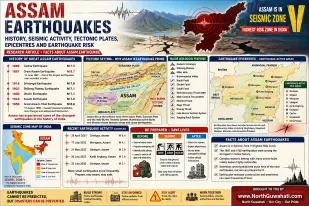
Assam Earthquakes. Assam Seismic Activity. List of Great Assam Earthquakes.Seismic Zone for Assam. Geographical References of the Tectonic Plates in Assam. Epicenter of Earthquakes in Assam. India Earthquake Report. Disaster Management Assam.
Assam Earthquakes
Assam ranks among the most earthquake-prone regions of India. The state sits in a highly active tectonic region where the Indian Plate interacts with the Eurasian Plate and the Indo-Burma tectonic system. Several active faults and thrusts cross or influence Assam and the surrounding Northeast India region.
Because of this geological setting, Assam has experienced many strong earthquakes throughout history. The 1897 Great Assam Earthquake and the 1950 Great Assam–Tibet Earthquake stand among the most powerful earthquakes associated with the region.
Why Does Assam Experience So Many Earthquakes?

Tectonic forces constantly reshape the land beneath Assam. The Indian Plate continues to move northward and interacts with the Eurasian Plate. At the same time, the Indo-Burma region accommodates complex tectonic movement.
These movements create stress inside the Earth’s crust. When rocks suddenly release accumulated stress along faults, they generate earthquakes.
Several important geological features influence Assam’s earthquake activity, including:
- Eastern Himalaya
- Shillong Plateau
- Mikir Hills
- Brahmaputra Valley
- Kopili Fault
- Dhubri Fault
- Dauki Fault
- Main Boundary Thrust
- Main Central Thrust
- Mishmi Thrust
- Naga Thrust
- Disang Thrust
- Indo-Burma tectonic system
- Sagaing Fault system
These structures make Assam and the wider Northeast one of India’s most seismically active regions.
Assam Seismic Zone
Assam falls under Seismic Zone V, which represents the highest earthquake-hazard category in India’s seismic zoning system.
The seismic-zone classification does not predict when an earthquake will occur. Instead, it indicates the level of earthquake shaking that engineers and planners should consider while designing buildings and infrastructure.
Therefore, people in Assam should treat earthquake-resistant construction as a major safety priority.
History of Great Assam Earthquakes
Assam and the surrounding Northeast have experienced several major earthquakes. Historical records show that powerful earthquakes have repeatedly affected the region.
| Year | Earthquake | Approx. Magnitude | Epicentral Region |
|---|---|---|---|
| 1869 | Cachar Earthquake | 7.5 | Cachar and Barak Valley |
| 1897 | Great Assam Earthquake | 8.7 | Shillong Plateau |
| 1918 | Srimangal Earthquake | 7.6 | Sylhet region |
| 1923 | Shillong Plateau Earthquake | 7.1 | Shillong Plateau |
| 1930 | Dhubri Earthquake | 7.1 | Western Assam |
| 1943 | Assam Earthquake | 7.2 | Assam and Northeast India |
| 1950 | Great Assam–Tibet Earthquake | 8.6 | Eastern Assam and Tibet |
These earthquakes demonstrate the enormous seismic energy that the region can release.
The 1897 Great Assam Earthquake
The 12 June 1897 Great Assam Earthquake ranks among the largest earthquakes in the history of the Indian subcontinent.
Scientists estimate its magnitude at approximately 8.7. The earthquake caused severe destruction across Assam, Meghalaya, Bengal, and nearby regions.
The earthquake produced extremely strong ground motion around the Shillong Plateau. Historical reports describe widespread building damage, ground deformation, and major changes to the landscape.
Researchers associate the earthquake with major fault movement beneath the Shillong Plateau. The event continues to attract scientific interest because it provides important evidence about the tectonic behaviour of Northeast India.
The 1950 Great Assam–Tibet Earthquake
On 15 August 1950, a massive earthquake struck the eastern Himalayan region.
The earthquake reached approximately magnitude 8.6. It caused extensive damage across Assam, Arunachal Pradesh, Tibet, and adjoining areas.
The earthquake triggered numerous landslides. Huge quantities of rocks, soil, and debris entered rivers and changed river channels. These changes also increased flooding and created additional hazards after the earthquake.
Scientists consider the 1950 earthquake one of the strongest continental earthquakes ever recorded.
Where Do Earthquakes Occur in Assam?
Earthquakes do not occur at a single location in Assam. Several tectonic structures generate earthquakes across different parts of the state.
Upper Assam and Eastern Assam
Eastern Assam lies close to the active tectonic systems of Arunachal Pradesh and the eastern Himalaya. The Mishmi Thrust and nearby structures influence this region.
Central Assam
Central Assam also experiences frequent seismic activity. The Kopili Fault plays an important role in the area’s earthquake hazard.
The 28 April 2021 Sonitpur earthquake, which had a magnitude of approximately 6.4, clearly demonstrated the seismic potential of central Assam.
Western Assam
Western Assam lies near the Dhubri Fault and other tectonic structures. The region has experienced several historical earthquakes.
Shillong Plateau and Meghalaya
The Shillong Plateau has experienced some of the most powerful earthquakes in Northeast India’s history, including the 1897 Great Assam Earthquake.
Karbi Anglong and Kopili Fault Region
The Karbi Anglong region lies near the active Kopili Fault system. Researchers consider this region an important source of earthquake hazard in Assam and Northeast India.
Major Tectonic Features Around Assam
Scientists use several major faults and tectonic structures to understand earthquake activity in Assam.
Kopili Fault
The Kopili Fault runs through Northeast India and plays an important role in Assam’s seismic activity. Scientists have linked several earthquakes in the region to this fault system.
Dhubri Fault
The Dhubri Fault extends through western Assam and forms an important tectonic structure near the western side of the Shillong Plateau.
Dauki Fault
The Dauki Fault runs along the southern edge of the Shillong Plateau. Movement along this fault can affect Assam, Meghalaya and Bangladesh.
Mishmi Thrust
The Mishmi Thrust lies in eastern Arunachal Pradesh. It forms part of the complex tectonic system near the eastern end of the Himalaya.
Main Boundary Thrust
The Main Boundary Thrust forms one of the important tectonic structures of the Himalayan region. It accommodates part of the crustal deformation caused by the continuing movement of the Indian Plate.
Main Central Thrust
The Main Central Thrust represents another major Himalayan tectonic structure. It helps scientists understand the deformation and uplift of the Himalaya.
Naga and Disang Thrust Systems
The Naga and Disang thrust systems influence the tectonic environment of Nagaland, Manipur, and nearby areas. Their movement contributes to the broader seismic activity of Northeast India.
Sagaing Fault
The Sagaing Fault in Myanmar forms another important active fault in the regional tectonic system. Its movement influences the earthquake environment of the broader Northeast India–Myanmar region.
Geographical Position of the Tectonic Plates
Assam occupies a complicated tectonic setting rather than a simple boundary between two plates.
The broad geographical relationship looks like this:
Tibetan Plateau and Eurasian Plate
↓
Eastern Himalaya
↓
Arunachal Pradesh and Assam
↓
Brahmaputra Valley
↓
Shillong Plateau and Mikir Hills
↓
Bangladesh and Bengal Basin
The Indian Plate continues to move northward and interacts with the Eurasian Plate. The Indo-Burma region also accommodates tectonic movement to the east and southeast.
The Shillong Plateau forms an important crustal block within this larger tectonic system. The surrounding faults and thrusts allow scientists to study how geological stress develops across Northeast India.
Assam Earthquake Epicentres
Scientists record earthquake epicentres across many parts of Assam and the neighbouring states.

Common earthquake-active areas include:
- Sonitpur
- Nagaon
- Morigaon
- Udalguri
- Karbi Anglong
- Goalpara
- Cachar
- Hailakandi
- Dima Hasao
- Arunachal Pradesh
- Meghalaya
- Nagaland
- Manipur
- Mizoram
The National Centre for Seismology (NCS) regularly records earthquakes across Northeast India.
Small earthquakes occur frequently in the region. Most of them do not cause serious damage, but their occurrence confirms that the region remains tectonically active.
What Is the Assam Seismic Gap?
Scientists sometimes use the term Assam seismic gap to describe a region that has experienced relatively fewer major earthquakes compared with neighbouring seismic zones over a particular historical period.
Researchers study such areas because a lack of recent large earthquakes does not necessarily mean that tectonic stress has disappeared.
However, people should not interpret the term “seismic gap” as a countdown to a future earthquake.
A seismic gap can help researchers estimate long-term earthquake hazard, but it cannot tell us the exact date of the next major earthquake.
Could Assam Experience Another Great Earthquake?
Yes. Assam and Northeast India can experience another major earthquake in the future.
Scientists continue to identify a high level of long-term seismic hazard across the region. However, researchers cannot currently predict the exact date, location, and magnitude of a future earthquake.
This distinction matters.
Earthquake hazard assessment estimates the long-term possibility of strong shaking.
Earthquake prediction would require scientists to determine exactly when and where a damaging earthquake will occur.
Modern science cannot yet make such precise predictions.
What Does Recent Research Say About Future Earthquakes?
Recent scientific studies continue to show significant earthquake risk across Northeast India and the Shillong Plateau.
Researchers use:
- Historical earthquake records
- Active-fault studies
- Geological mapping
- GPS measurements
- Seismic monitoring
- Ground-motion modelling
- Probabilistic seismic-hazard analysis
to estimate future earthquake hazard.
Recent studies of the Shillong Plateau have modelled numerous seismic sources, faults, and lineaments. These studies show that several parts of the region could experience strong ground motion during future earthquakes.
However, these studies provide probability-based hazard estimates. They do not predict that a major earthquake will occur on a specific day, month, or year.
Latest News About the Probability of the Next Earthquake in Northeast India
People often search online for statements such as:
“Will a major earthquake hit Assam soon?”
“Is a big earthquake coming to Northeast India?”
“Have scientists predicted the next Assam earthquake?”
At present, no reliable scientific method can provide the exact date of the next major earthquake.
Scientists can identify areas with high seismic hazard, but they cannot accurately predict the exact timing of a major earthquake.
Small earthquakes also do not automatically indicate that a large earthquake will follow.
A series of small earthquakes may represent normal background seismic activity, an aftershock sequence, or a local earthquake swarm. Researchers need additional geological and seismological evidence before they can draw meaningful conclusions.
Therefore, people should treat social-media claims about an imminent “mega earthquake” with caution and depend on information from recognised institutions such as the National Centre for Seismology, India Meteorological Department, Geological Survey of India and Assam State Disaster Management Authority.
India Earthquake Monitoring
The National Centre for Seismology (NCS) operates India’s earthquake monitoring system and publishes earthquake information.
The NCS catalogue provides important details such as:
- Date and time
- Latitude
- Longitude
- Depth
- Magnitude
- Epicentre
- Location
People can use the official NCS earthquake catalogue to check recent seismic activity across Assam and the rest of India.
Assam Disaster Management
The Assam State Disaster Management Authority (ASDMA) manages disaster preparedness and response activities in Assam.
Earthquake preparedness becomes especially important because Assam faces several natural hazards, including floods, landslides and storms.
Authorities, institutions, and residents should work together to reduce earthquake risk.
Important measures include:
Before an Earthquake
Secure heavy furniture and shelves.
Keep heavy objects away from beds and seating areas.
Identify safe places inside the building.
Prepare an emergency kit.
Keep important documents and emergency contacts accessible.
Learn how to switch off electricity and gas safely.
Follow earthquake-resistant construction standards.
During an Earthquake
Follow the simple rule:
Drop – Cover – Hold On.
Drop to the ground.
Take cover under a strong table or desk.
Hold on until the shaking stops.
Stay away from windows, glass, and objects that can fall.
Do not use lifts during an earthquake.
After an Earthquake
Check yourself and others for injuries.
Move carefully away from damaged structures.
Avoid fallen electric wires.
Expect aftershocks.
Do not enter severely damaged buildings unless authorities declare them safe.
Follow instructions from government authorities and emergency services.
Frequently Asked Questions About Assam Earthquakes
Is Assam located in a high-risk earthquake zone?
Yes. Assam falls under Seismic Zone V, India’s highest seismic-hazard category.
Which earthquake was the strongest in Assam?
The 1897 Great Assam Earthquake and the 1950 Great Assam–Tibet Earthquake rank among the strongest earthquakes associated with Assam and the Northeast. Both reached approximately magnitude 8.6–8.7.
What was the magnitude of the 1897 Assam earthquake?
Scientists generally estimate the magnitude at approximately 8.7.
What was the magnitude of the 1950 Assam earthquake?
The USGS records the 1950 Great Assam–Tibet Earthquake at magnitude 8.6.
Where did the 1897 earthquake occur?
The earthquake occurred in the Shillong Plateau region, south of the Brahmaputra Valley.
Where did the 1950 earthquake occur?
The 1950 earthquake occurred in the eastern Himalayan and Assam–Tibet region.
Is Guwahati vulnerable to earthquakes?
Yes. Guwahati lies in a region with significant earthquake hazard. Building quality, soil conditions, local geology, population density and infrastructure all affect the level of risk.
Can scientists predict the next earthquake in Assam?
No. Scientists can estimate long-term earthquake probability and hazard, but they cannot accurately predict the exact time, location, and magnitude of the next major earthquake.
Do small earthquakes indicate that a big earthquake will happen soon?
No. Small earthquakes do not necessarily mean that a major earthquake will follow.
What is the Assam seismic gap?
Researchers use the term to describe certain areas with a relative lack of large earthquakes during a particular historical period. Scientists study these areas to improve long-term seismic-hazard assessments.
Which agency provides official earthquake information in India?
The National Centre for Seismology (NCS) provides official earthquake information for India.
Which agency manages disaster preparedness in Assam?
The Assam State Disaster Management Authority (ASDMA) coordinates disaster-management activities in Assam.
What should I do during an earthquake?
Follow Drop, Cover, and Hold On. Stay away from windows and falling objects, and avoid using lifts.
Assam Earthquake Conclusion
Assam has experienced some of the largest earthquakes in the history of the Indian subcontinent. The 1897 Great Assam Earthquake and the 1950 Great Assam–Tibet Earthquake demonstrate the enormous seismic potential of the region.
The Indian Plate, Eurasian Plate, Indo-Burma tectonic system, and several active faults continue to shape Northeast India’s geology. Assam’s Seismic Zone V classification confirms the state’s high earthquake hazard.
Scientists continue to monitor the region and improve earthquake-hazard models. However, no scientist or institution can currently predict the exact date of the next major earthquake.
Instead of worrying about unverified earthquake predictions, residents should focus on earthquake-resistant buildings, public awareness, emergency preparedness, and reliable information from official agencies.
For Assam and Northeast India, preparedness remains the most practical defence against future earthquakes.
Tags
Explore more